
Curaçao's Tourist Tax Is Changing— Probably!

Here's What Owners Should Know
Curaçao is considering the most significant change to how it taxes tourism in a decade. The shape of it is simple. Today the island taxes the stay. The proposal would tax the arrival instead.
For anyone who owns and rents a property here, that's not a technical adjustment. It changes who collects the tax, who bears it, how much the island raises and which kind of guest pays the most. This briefing sets out what's proposed, what's actually been decided and what it would mean in practice.
One thing first, because it's the only part that requires action today. Nothing has changed. The 7% turnover tax on accommodation remains the law and should continue to be charged, collected and remitted exactly as it is now. Everything below concerns a proposal that hasn't been adopted.
1. The system as it stands
Accommodation let for ninety days or less carries 7% turnover tax, known as OB. It's worked this way since January 1 , 2016, when accommodation became subject to the 7% OB rate.
The mechanics matter for what follows. The guest bears the cost. The owner or property manager is responsible for collecting it and remitting it through the OB system. The tax attaches to the accommodation transaction, which means collection depends on that transaction being reported.
2. What's being proposed
The 7% accommodation levy would be abolished and replaced with a Tourist Entry Tax charged to arriving air passengers.
The rate. Draft legislation has been reported as contemplating approximately $65 USD per person. An earlier illustrative calculation used $60. More recently, public discussion has included a $75 figure. The final rate isn't settled.
The exemptions. Curaçao residents and transit passengers would be exempt under the proposal. Reporting indicates the final legislation may also exempt children and certain other groups, though those details aren't confirmed.
The scope. It would apply broadly to passengers arriving by air.
The status. The legislation hasn't been adopted. The Board of Financial Supervision (Cft), the board supervising Curaçao's public finances, has noted that the legislative process and practical implementation are incomplete and has asked the government what it will do if implementation slips. An earlier round of reporting in mid 2025 expected introduction no later than 2026. That timeline has already moved once.
3. The case for the change
The argument isn't simply about the tax rate. A significant part of it is about collection and closing the gap between declared and undeclared accommodation.
Under the present system, the 7% reaches government only when the accommodation provider declares the rental and remits the tax. That creates an enforcement gap. A compliant hotel, villa owner or property manager collects the 7%. An undeclared or under-reported rental can potentially avoid the accommodation levy.
Government reporting has specifically identified non-compliance among private accommodation providers as one of the weaknesses of the current system. That's an important part of the rationale for moving the principal tourism levy to the point of entry. Instead of depending on every accommodation transaction being declared, every qualifying arriving visitor would be brought into the collection system.
It's important to be precise about the language. Non-compliance can include failure to register, inaccurate reporting or failure to remit. It shouldn't automatically be described as fraud. The broader issue is tax leakage and the difficulty of enforcing a transaction-based levy across a fragmented private-rental market.
For compliant owners, that matters. Moving collection to the border would substantially reduce this particular competitive gap because a guest staying in an undeclared rental would no longer avoid the tourism levy simply because the accommodation transaction wasn't reported.
The administrative logic is straightforward. An arrival-based charge can reach visitors independently of the accommodation transaction. It also sits within a broader government direction toward indirect and consumption-based taxation.
The original framing, when Minister Cooper announced the concept in April 2025, was narrower than it is now. Part of the proceeds was then described as funding a guarantee fund to help local entrepreneurs secure financing.
4. The money involved (XCG)
This is the part receiving less public attention and it probably deserves more.
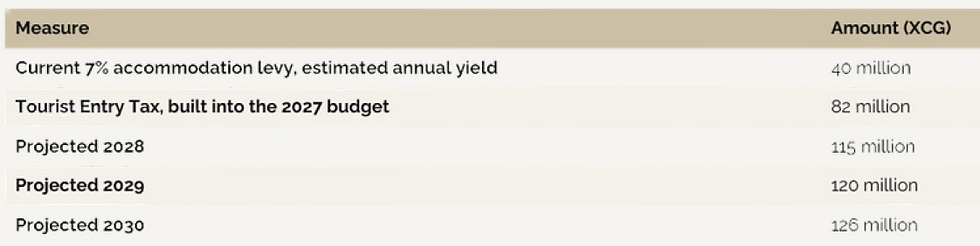
Two details sharpen this considerably.
First, according to reporting on the 2027 budget assumptions, the 82 million budgeted for 2027 represents only 75% of the government's estimated maximum annual yield. That allowance is intended to account for possible delay or phased implementation.
Second and more simply, a levy producing roughly 40 million would be replaced by one budgeted at 82 million in its first year. That's not simply a different way of collecting the same money. On current government projections it's roughly 42 million more if the forecast is achieved.
There's also a fiscal risk worth noting. Curaçao's draft 2027 budget projects an ordinary-service surplus of around 66 million, but that same budget already assumes approximately 82 million in revenue from the new Tourist Entry Tax. In other words, the projected tax revenue is larger than the entire budget surplus. If implementation is delayed or revenue falls short of expectations, the effect on the budget could therefore be significant. The Cft has specifically raised this risk because the legislation and practical arrangements aren't yet complete.
5. What it would mean for a compliant owner
Two things about this proposal genuinely favour an owner who plays by the rules.
Fairness. If you register your rental, report your revenue and remit your 7%, you're currently competing against accommodation that may not do the same. Moving the principal tourism levy to the border would substantially reduce that particular gap. A guest staying in an undeclared rental would no longer avoid the entry levy simply because the booking wasn't reported.
Administration. If the 7% is genuinely abolished, it stops being something you calculate, collect, reconcile and remit. For an owner managing their own property, that's a real reduction in work and in exposure.
6. The objection, which is about distribution
A percentage scales with spending. A flat fee doesn't.
At $65 USD per person, the point at which 7% of an accommodation bill equals the entry tax is approximately $929 per person. Below that, the entry tax costs the guest more. Above it, less.
Two examples make it concrete.

The change therefore tends to favour higher-value accommodation and longer stays while placing a proportionately greater burden on lower-cost, shorter stays and larger travelling parties. Note also that the 7% applies to one accommodation bill while the entry tax applies per person. Large parties in modest accommodation can therefore be particularly affected and children may or may not be exempt in
the final text.
7. The part worth watching closely
A flat fee is charged once on arrival regardless of how long someone stays. The tax per night therefore falls the longer the visit runs.
CTB's August 2026 report gives us something better than a one-month snapshot because it places August 2026 directly beside August 2025. The same broad pattern appears in both years. Europe averaged approximately 11.8 nights in August 2026 versus 11.7 in August 2025. South America averaged 6.2 versus 6.1, North America 6.0 in both years and the Caribbean 4.7 versus 5.5. At a $65 fee, the 2026 figures produce the
following effective cost per night:

On the August 2026 averages, the effective entry-tax cost per night for a Caribbean visitor would be roughly two and a half times that of a European visitor. More importantly, the broad difference in stay length isn't unique to one month. Europe was also close to twice the average stay of North and South American visitors in August 2025.
There is also some real-world Caribbean experience to consider. CTB has said it doesn't expect the entry fee to significantly reduce tourist numbers and has pointed to Bonaire's experience. Bonaire introduced a $75 Visitor Entry Tax in July 2022, replacing its previous room and car-rental taxes with a charge collected directly from visitors. Bonaire's government says the old system made correct collection and remittance difficult and
taxes were often not fully collected or remitted.
Since then, Bonaire has continued to record strong stayover tourism. It recorded 169,706 stayover visitors in 2023 and a record 182,181 in 2024, an increase of 7.35%. That doesn't prove the tax had no effect on demand — we can't know what tourism would have looked like without it. But it does provide a recent regional example of a relatively high flat visitor tax operating alongside continued tourism growth.
Aruba offers a different model. Since July 2024, air visitors have generally paid a $20 Sustainability Fee through the island's online ED Card system. Unlike Bonaire, however, Aruba didn't eliminate its accommodation tax when the new fee was introduced.
How Curaçao would compare
These aren't directly comparable taxes. Caribbean destinations use a mix of entry fees, passenger levies, departure taxes and accommodation taxes. That said, they provide useful context for where Curaçao's proposed charge would sit within the region.

Research from other tourism-dependent islands also suggests that visitors don't all respond to higher costs in the same way. One study of Aruba (2005) estimated that a 10% increase in the effective price of a trip would be associated with only about a 0.2% decline in Dutch demand and 1.2% in US demand, compared with roughly 7.7% for Venezuelan visitors. Separate research on the Maldives found that a 10% increase in tourism tax was associated with a 5.4% reduction in overall tourism demand.
Neither study tells us how visitors will respond to a Curaçao entry tax. But combined with Curaçao's own differences in average stay length, they raise a worthwhile question. Could some of the markets facing the highest effective entry-tax cost per night also be among the more price-sensitive? Existing research can't answer that question for Curaçao, but it suggests the issue deserves closer examination.
What is clear is that a fixed per-person charge won't affect every visitor in the same way and that's worth understanding before the final rate and exemptions are fixed.
The Advisory Council has raised a separate concern. Funding a larger share of the budget from arrivals could deepen the government's financial dependence on tourism at the same time it says it wants to diversify the economy.
8. What owners should do now
Operationally, nothing. Keep charging and remitting the 7%. It remains the law and will remain so until enacted legislation says otherwise.
Three things are worth preparing.
Plan for 2027 pricing. If you're quoting 2027 rates that assume the 7%, decide now how you'd handle abolition part way through a season. A rate card built on a tax that disappears is a conversation with a guest either way and it's better to have decided the answer in advance.
Expect questions. A charge collected at the border isn't yours and you won't administer it, but you'll be the one asked about it, particularly by repeat guests who remember the old arrangement.
Watch the rate. A move from US$60 to US$75 is a 25% increase in the charge itself and its effect will vary substantially according to party size, length of stay and accommodation spend.
Where this leaves us
The existing system has the advantage of proportionality. Tax rises with what a guest spends. Its weakness is collection.
The proposed system has the advantage of universality and administrative reach. Substantially more visitors can be brought into the tax base. Its weakness is that a flat fee places a proportionately greater burden on lower-spending, shorter-staying and larger travelling parties.
For a compliant owner, replacing the 7% could simplify administration and improve competitive fairness. For Curaçao, however, the proposal represents something larger than a different way of collecting the same tax. On current budget projections it represents a material increase in tourism-derived government revenue.
The questions worth asking are therefore not simply whether an entry tax should exist, but what the rate should be, who should be exempt, how the burden would be distributed across the visitor economy and how dependent the island should become on this revenue stream.
For now, the practical position is straightforward. The 7% remains in force. The Tourist Entry Tax is written into government planning for 2027, but the legislation and its implementation are unfinished. Operate under the existing rules until an enacted change provides otherwise.


Comments